

Combine CX metrics to prove impact and build a business case
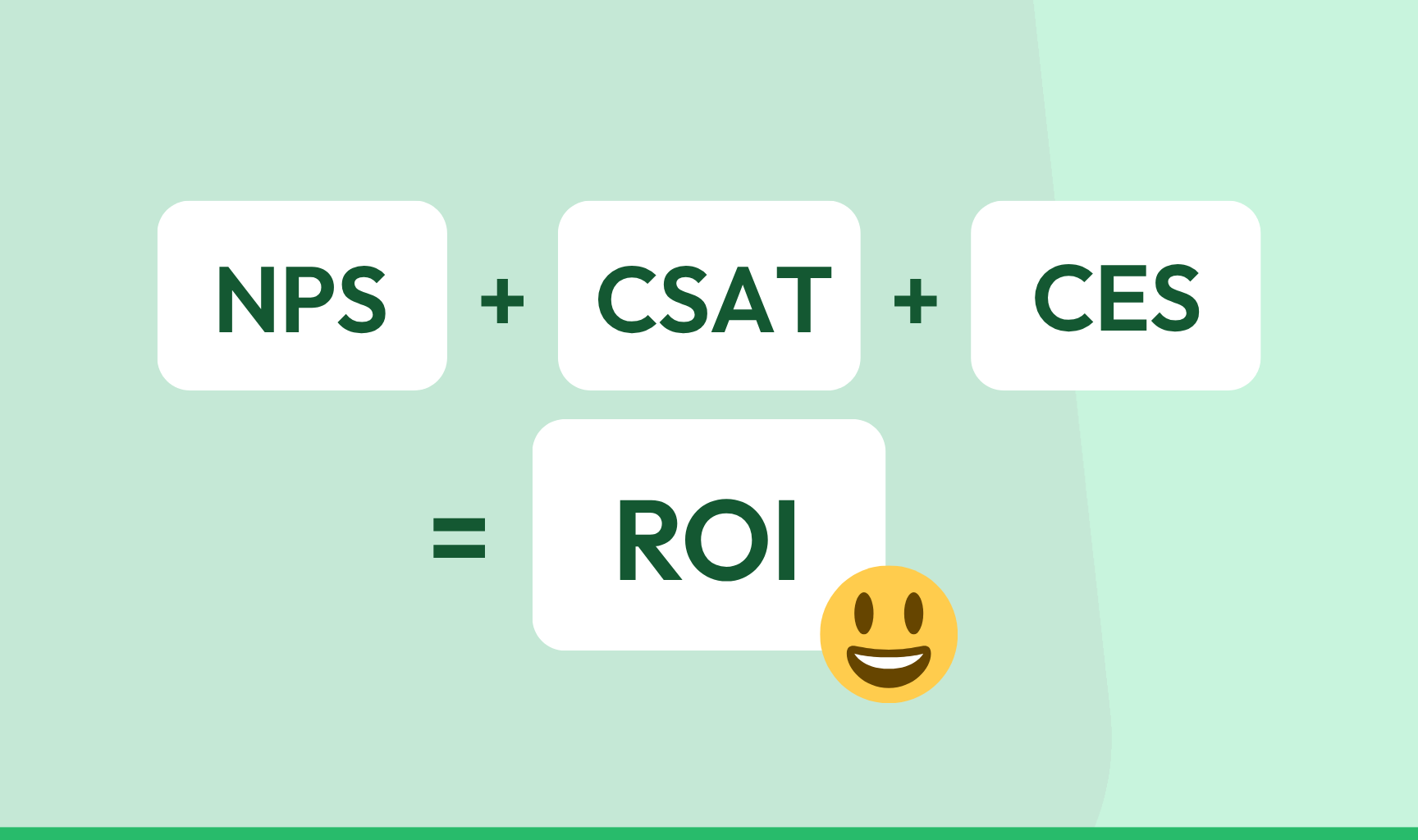
Combining customer experience metrics gives you something a single score never can: a clear, defensible picture of how your program drives business outcomes. When you run Net Promoter Score®, Customer Satisfaction Score, and Customer Effort Score together, you can calculate the return on your CX investment, predict where revenue risk is building, and walk into a budget conversation with numbers the CFO will recognize.
Key takeaways
Why one metric is never enough
NPS gives you a number leadership will recognize and a benchmark you can track quarter on quarter. But on its own, it tells you the outcome without the cause. A score drop could point to a service failure, a product gap, a pricing issue, or something that happened in one channel and not others. Without the supporting signal, you are guessing at what to fix.
CSAT fills part of that gap, but a different part than most teams expect. It is most valuable not as a headline figure but as a diagnostic tool. When CSAT is broken down by touchpoint, team, or product line, it shows you exactly where the experience diverges from what customers expect. The overall score matters less than the variance within it.
CES tends to be the metric CX teams underinvest in, and it is often the most predictive of the three. Customers who find interactions high-effort do not always complain. They do not always score you poorly on CSAT. They just quietly leave. And the signal shows up in CES before it shows up anywhere else.
The real value of running all three is triangulation. A falling NPS alongside stable CSAT and rising CES tells a specific story: the product or relationship is broadly fine, but operational friction is eroding loyalty. That is a very different problem to solve than a falling NPS driven by declining satisfaction at a specific touchpoint. Combined metrics give you the context to prioritize correctly and the evidence to make the case for doing so.
What each metric adds to your business case
Net Promoter Score®: the revenue argument
NPS is the metric most likely to open a boardroom door, for a simple reason. There is peer-reviewed research linking NPS improvement directly to revenue growth, which means finance teams are more likely to accept it as a basis for investment modelling than they would a satisfaction score alone. That gives CX leaders something rare: a customer sentiment metric with an independently verified financial conversion rate.
The practical implication is that NPS improvement can be expressed as a pound figure rather than a point movement. That shifts the conversation from ‘our customers are happier’ to ‘here is what a program that moves NPS by X points is worth to this business.’ It is not a guarantee of revenue, but it is a credible starting point for a budget conversation.
Customer Satisfaction Score: the cost argument
CSAT makes a different kind of financial case. Declining satisfaction at specific touchpoints predicts support volume, complaint escalations, and repeat contact, all of which carry direct cost. Improving CSAT, particularly in post-purchase and service interactions, typically reduces follow-up contact rates, which reduces cost to serve. That cost line is often easier to model conservatively than revenue projections, and it tends to face less scrutiny as a result.
It also gives the business case a second independent line of evidence. A CFO who is sceptical of revenue projections based on NPS benchmarks may be more persuaded by a cost reduction argument grounded in your own support data. Running both strengthens the case by making it less dependent on any single assumption.
Customer Effort Score: the churn argument
CES makes the retention case, and retention is where the financial argument often lands hardest. High-effort interactions are one of the strongest leading indicators of churn, and they frequently surface before dissatisfaction does. By the time CSAT drops, some customers have already made their decision. CES picks up the signal earlier, which means you have more time to act.
The financial logic of retention is compelling because the benefit compounds. Reducing churn by a few percentage points does not just protect the revenue from those customers in year one; it shifts the whole shape of the revenue base over time. That compounding effect is what makes the retention argument so powerful in a business case, and CES is the metric that gives you the operational lever to demonstrate it.
How combining metrics helps you calculate ROI
Running NPS, CSAT, and CES together gives you the inputs for a financial model rather than a collection of separate scores. Each metric maps to a different line in the calculation: NPS to revenue growth, CES to retained revenue through churn reduction, CSAT to cost savings from reduced support volume.
Here is what that looks like with real numbers. Take an organization with £10 million in annual revenue, 1,200 customers, and a 10% churn rate.
The LSE/Temkin benchmark maps 7 NPS points to 1% revenue growth, so each point is worth roughly 0.14%. A 3-point improvement, a realistic year-one target, represents 0.43% revenue growth. On £10 million, that is approximately £43,000.
On the retention side, a 5% CES-driven improvement in churn rate means 60 fewer customers leave each year (5% of 1,200). At an average revenue per customer of £8,333, that protects roughly £210,000 in revenue that would otherwise have been lost.
CSAT contributes a further £14,000 through reduced support costs and improved renewal rates following a 5-point improvement, based on Forrester CX Index modelling.
Combined, that is an estimated annual impact of £267,000 against a single platform investment.
Those figures will look different for your business depending on revenue, customer base, and churn rate. The SmartSurvey ROI calculator lets you input your own numbers and adjust for realistic improvement targets. The output breaks down by metric so you can see where the return is most concentrated.
The research behind the numbers
The benchmarks used in CX business cases come from a small set of well-cited studies. These are the four most commonly referenced.
7-point NPS improvement = approximately 1% revenue growth
Source: London School of Economics / Temkin Group
The LSE study tracked NPS and revenue growth across multiple industries over several years. The finding held across sectors, which is why it travels well in boardroom conversations. At £50 million revenue, a 7-point improvement is worth £500,000. At £100 million, it is £1 million.
5% retention improvement = 25% to 95% profit lift
Source: Bain & Company
The range reflects how dramatically the economics vary by industry. In high-margin SaaS or financial services, the upper end is achievable. In lower-margin sectors the impact is smaller but still material. The mechanism is the same in every case: retained customers cost less to serve, buy more over time, and generate referrals.
Effective CX programs reduce churn by approximately 15%
Source: McKinsey
McKinsey looked at organizations that had moved from reactive service to structured, insight-driven CX programs. The 15% figure is the median improvement. Organizations that combined measurement with systematic loop-closing tended to see the largest gains.
115+ hours saved per 10,000 survey responses
Source: SmartSurvey
This is the time saved through AI-powered thematic and sentiment analysis compared to manual categorisation of open-text responses. For a team running quarterly NPS programs at scale, that is more than two full working weeks per cycle. Those hours shift from counting to acting.
How to build a business case using CX metrics
A business case for CX investment needs to do three things: demonstrate the current cost of poor experience, model the return from improvement, and show a credible path to achieving it. Combined metrics give you the evidence for all three.
Step 1: Establish your baseline
Before you can show impact, you need to know where you are starting. Run NPS, CSAT, and CES across your key customer touchpoints for a quarter and segment by customer tier, product, and channel. This does two things. It shows you where the experience varies most, which is where investment will have the most effect. And it gives you a benchmark position to measure progress against, which is what makes the ROI model credible rather than theoretical.
Step 2: Model the financial impact
Apply the benchmarks in the research section above to your own revenue, churn rate, and customer numbers. Use conservative improvement targets based on your baseline, not the upper end of what the research shows is possible. A modest, well-evidenced projection survives scrutiny. An optimistic one invites challenge.
Build the model in three lines: NPS revenue impact, CES retention impact, CSAT cost impact. Keep each calculation separate so the assumptions are transparent. A CFO who questions the NPS projection does not need to throw out the whole case if the other lines stand on their own.
Step 3: Connect improvement to action
Numbers in a spreadsheet do not move a business case forward on their own. The question leadership will ask is: how will you know when it is working? The answer needs to cover three things: how you track metric movement in real time, how you close the loop on the responses that matter, and how CX data reaches the people and systems already making decisions.
A live dashboard showing NPS, CSAT, and CES moving together, segmented by touchpoint or customer tier, gives leadership a view of program performance without needing a quarterly report to prompt a conversation. Score movements become visible as they happen, and the connection between an initiative and a metric shift becomes traceable rather than assumed.
Closing the loop converts that visibility into credibility. When Detractor cases are routed, followed up, and resolved, and that activity sits alongside the score data, the business case stops being projected. SmartCX connects NPS, CSAT, and CES to case management so every response that needs a follow-up gets one. Power BI integration puts CX metrics alongside financial and operational data in the dashboards leadership already reviews. Direct Salesforce and HubSpot connectivity means account teams see customer sentiment in the tools they work in every day. When CX data flows into the existing tech stack rather than sitting separately, it becomes part of how the business makes decisions.
Step 4: Report on outcomes, not just scores
The business case needs to be renewed every time investment is reviewed. The difference between a program that keeps its budget and one that gets cut is usually whether leadership can draw a clear line between what CX is doing and what is happening to business outcomes.
That means reporting on actions and results alongside scores. Not just ‘NPS improved by 4 points’ but ‘NPS improved by 4 points following the service recovery initiative in Q2, which closed 340 Detractor cases and reduced churn in that cohort by 11%.’ That is the kind of reporting that earns the next round of investment.
Calculate your CX ROI — use the SmartSurvey ROI calculator to model the financial impact of improving your NPS, CSAT, and CES scores against your own revenue, customer numbers, and churn rate.
Frequently asked questions
What is the difference between NPS, CSAT, and CES?
Each metric predicts a different business outcome. NPS is the strongest predictor of revenue growth. CSAT is most useful for diagnosing where the experience is breaking down at touchpoint level. CES is the strongest leading indicator of churn. Running all three gives you coverage across the full picture: whether customers will stay, where friction is building, and which specific interactions are letting them down.
How do I calculate the ROI of a CX program?
Model each metric separately against your own numbers: NPS to revenue growth, CES to retained revenue through churn reduction, CSAT to cost savings from reduced support volume. Add the three lines together for a total projected return. The SmartSurvey ROI calculator does this automatically if you would rather input your figures and let it run the maths.
How much does a 1-point NPS improvement affect revenue?
The LSE/Temkin benchmark maps 7 points to 1% revenue growth, so each point is roughly 0.14%. The figure is a benchmark, not a guarantee, and the relationship is stronger in some industries than others. Its value is less in its precision and more in giving you an independently verified conversion rate to put in front of finance, rather than a claim that cannot be substantiated.
What is a realistic CX improvement target in year one?
A 3-point NPS improvement, a 5-point CSAT gain, and a 5% retention improvement through CES reduction are all within reach in year one for organizations running structured programs. Where you start matters. A program launching from a low baseline will often move faster in the first year. One that is already well-run may see smaller absolute gains but stronger consistency over time.
Can AI really save 115 hours per 10,000 survey responses?
Yes, at scale. The saving comes from replacing manual reading, tagging, and categorisation of open-text responses with automated thematic and sentiment analysis. For low-volume programs the hours are fewer. For teams running continuous listening across multiple touchpoints, the saving is large enough to change what the team is able to do with its time rather than just how quickly it does the same things.
SmartCX connects NPS®, CSAT, and CES to business outcomes, so you can walk into the boardroom with quantified evidence, defend the budget, and show your program is moving the needle. Book a 30-minute call to get started.


Alex is a growth marketing leader who has led digital transformation through AI and technology across multiple organizations. With experience across SaaS and the customer experience space, he knows what it takes to turn technology into business impact. Alex shares knowledge on feedback collection, text analysis and feedback management, helping organizations get more value from their feedback programs.
See SmartSurvey in action


