

Why closing the outer loop is harder for CX leaders
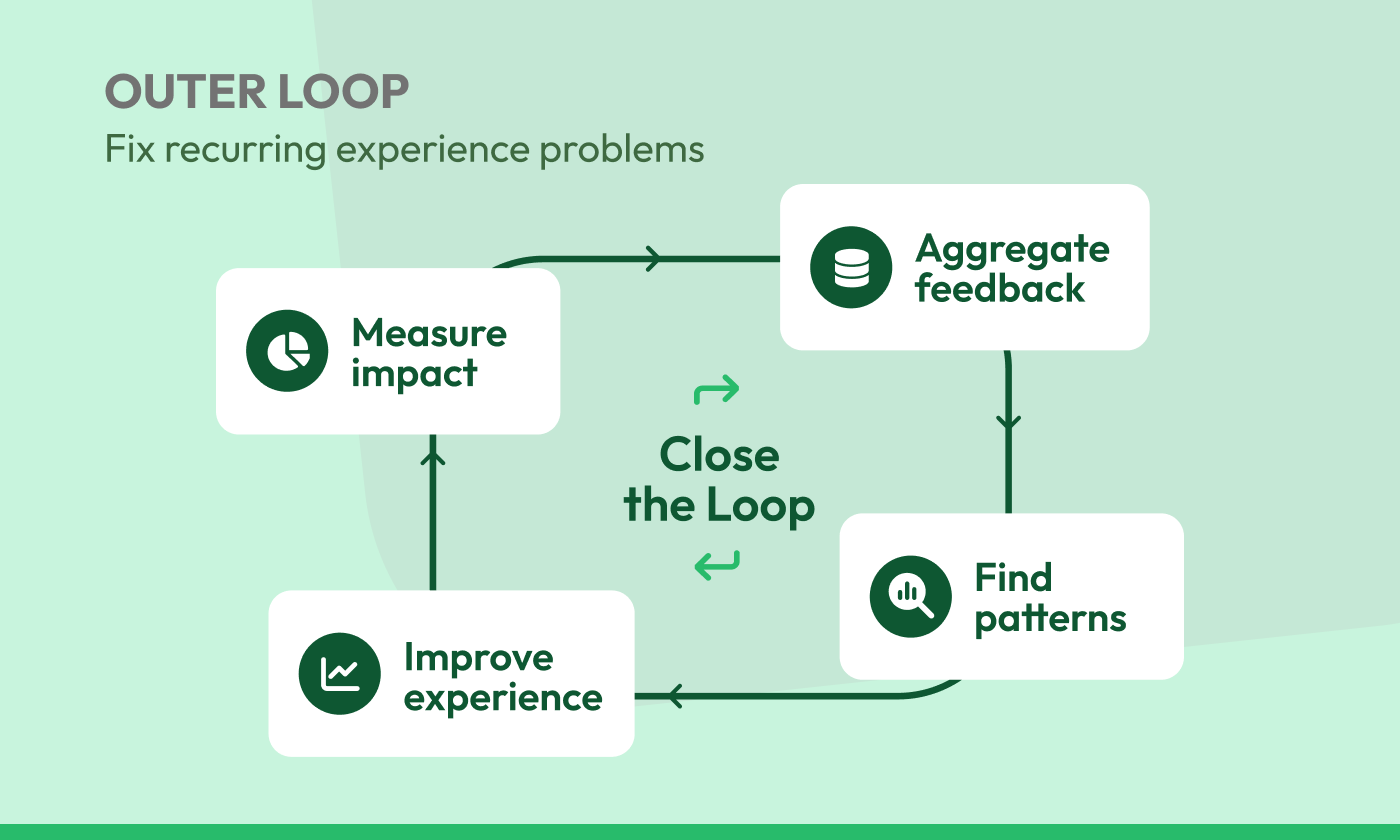
Most CX leaders know what the outer loop is supposed to do. Aggregate feedback, find the patterns driving score movement, fix the root causes, measure the impact. The framework is not complicated. Executing it is.
Closing an individual complaint is hard enough. But it is a contained problem. One customer. One issue. One owner. One resolution. The outer loop is a different kind of challenge entirely. It requires analysis at scale, influence across functions, and a cultural shift that most organizations have not made yet. Each of those is a real obstacle. Most CX teams are dealing with all three at once.
Key takeaways
- Finding root causes requires going beyond high-level themes to sub-themes and verbatim, which is not practical manually at scale
- Even with the right analysis, outer loop fixes almost never sit within CX's direct control
- Building a data-backed business case is what gets other functions to act, not sharing feedback summaries
- The organizations making real progress on CX have moved from treating it as a compliance function to treating it as a commercial one
Finding root causes is harder than it looks
Responding to an individual complaint is straightforward. You read it. You understand what went wrong. You fix it. The outer loop asks a much harder question: why does this keep happening?
Answering that question properly requires analyzing feedback at a scale that is not possible by hand. Not because CX teams are not capable, but because the volume is too high and the signal is buried. Reading through thousands of open-text responses to find the themes driving score movement takes weeks. By the time you have a finding, the quarter has moved on.
The other problem is that surface-level themes are not specific enough to act on. Knowing that 'communication' is your highest-volume negative theme does not tell you what to fix. Is it the frequency of updates? The tone? The channel? The timing? Each of those has a different owner and a different solution. To get to the answer you need to drill down: from theme to sub-theme to the verbatim responses sitting underneath.
That drill-down is where genuine insight lives. It is also where most outer loop analysis stops, because doing it manually across thousands of responses is not realistic. Teams end up working with surface-level summaries and wondering why their recommendations do not gain traction. The analysis was not wrong. It just was not specific enough to be actionable.
The CX teams who get this right treat text analysis as a core capability, not an afterthought. They invest in tools that can group responses into themes automatically, surface the sub-themes within them, and let analysts drill into the verbatim quickly. That is what turns a feedback volume problem into a root cause identification problem. And root causes are something you can actually build a case around.
The fix almost never sits within CX
This is the part that catches a lot of CX leaders off guard. You do the analysis. You identify a clear pattern. You know what needs to change. And then you realize the team that needs to change it is product. Or operations. Or the contact center. Or IT.
CX teams rarely own the levers that drive the changes customers are asking for. They own the measurement. They own the insight. But fixing a broken digital journey, changing a fulfillment process, or updating how agents handle complaints requires another function to reprioritise their work. That is not a small ask.
The challenge is not usually that other teams disagree with the finding. It is that they have their own roadmaps, their own KPIs, and their own competing priorities. A CX insight that arrives as a slide in a monthly report is easy to acknowledge and park. It competes poorly against a product team's existing backlog or an ops team's cost targets.
The CX leaders who navigate this well are the ones who make it easy for other functions to see the problem themselves rather than being told about it. When a product team has direct visibility into the feedback themes that are appearing post-launch, the conversation is different. The problem is no longer CX's interpretation of customer sentiment. It is data the product team can see, interrogate, and take ownership of.
Visibility is a big part of the solution. The other part is relationship. CX leaders who build strong working relationships with product, ops, and technology before they need something from them are in a very different position to those who only show up when they have a request. The outer loop is a cross-functional effort. Treating it that way from the start changes how much traction you get.
Getting investment requires a different kind of evidence
There is a version of the outer loop conversation that goes nowhere. A CX leader presents a selection of customer verbatim, a theme summary, and a recommendation for change. The leadership team nods. Nothing happens. The reason is usually not that the recommendation was wrong. It is that the evidence was not in a language that drives decisions.
Leadership teams invest in things when they can see a return. That means the conversation about CX initiatives needs to happen in commercial terms, not satisfaction terms. Not 'customers are unhappy about X' but 'the customers who mention X have a churn rate significantly higher than those who do not, and fixing X is worth a quantifiable amount in retained revenue'.
That kind of evidence requires connecting your feedback data to your commercial data. It means knowing what the churn profile looks like for customers who mention a particular theme. It means being able to model what a meaningful reduction in that theme's frequency would mean for retention. And it means being able to show, after a fix has been made, that the metric actually moved.
The before-and-after story is what builds credibility over time. A CX leader who can walk into a planning cycle and say 'here is what we changed last quarter, here is how scores moved, here is the retention impact' is in a fundamentally stronger position than one who can only report the current NPS. One is presenting an outcome. The other is presenting a number.
Building that kind of evidence takes time to set up. But once it is working, it changes the relationship between CX and the rest of the business. You are no longer asking for investment. You are presenting a return.
Moving CX from a reporting function to a business driver
A lot of CX programs exist primarily to satisfy a reporting requirement. Regulatory bodies ask for it. Boards expect a score. Accreditations require evidence of customer feedback collection. So the program is built around producing those outputs, and the feedback data flows into a dashboard that gets reviewed quarterly and filed.
That is a legitimate use of a feedback program. It is not a CX strategy.
The organizations making real progress on customer experience have made a different decision. They have moved from asking 'what do we need to report?' to asking 'what does this data tell us we should change?' The feedback program is no longer an end in itself. It is an input into how the business operates.
That shift sounds straightforward but it is genuinely difficult to make. It requires senior sponsorship. It requires CX metrics to be tied to business outcomes in a way that leadership cares about. And it requires the CX function to operate differently. Less time producing reports. More time building evidence, influencing roadmaps, and tracking the impact of changes made.
The organizations that get there tend to share a few things. CX has visible executive sponsorship. The metrics that matter, NPS, CSAT, CES, churn rate, are discussed at leadership level alongside revenue and cost. And the CX team is seen as a source of commercial intelligence, not just satisfaction data.
Getting from a compliance-driven feedback program to that position takes time. But the outer loop is how you get there. Every root cause you identify, every initiative you influence, every before-and-after result you can show, is evidence that CX drives outcomes. That is what changes how the function is perceived and funded.
How SmartCX helps with the outer loop
The challenges described above are not going to disappear. But the right tools make each of them significantly more manageable.
On the analysis side, SmartCX's text and thematic analysis uses AI to group open-text responses into themes automatically. That makes the drill-down from high-level theme to sub-theme to verbatim practical at the scale most CX teams are working at. You can move from 'communication is a problem' to 'here is the specific sub-topic that is driving low scores, and here are the responses that prove it' in minutes rather than weeks. That specificity is what makes outer loop findings actionable rather than directional.
On the cross-functional ownership problem, SmartCX's shareable dashboards give product, operations, and other functions direct visibility into the themes and metrics that affect their area. Rather than receiving a summary from CX, those teams can see the data themselves, drill into it, and start to take ownership of what it means for their work. That shift from being told about a problem to seeing it directly changes how other functions engage with CX findings.
On the business case side, SmartCX's analysis tools help CX teams connect feedback themes to commercial outcomes. The ROI calculator lets you model the revenue impact of fixing a recurring issue before you walk into a planning meeting. And the before-and-after tracking built into the platform means that when a change ships, you can show whether it moved the metrics it was supposed to move. That is the evidence that turns CX from a cost center into a function that demonstrates return on investment.
For teams whose fixes sit in other systems, SmartCX integrates directly with Salesforce, HubSpot, and a range of other tools via API and webhooks. Outer loop findings can feed into the workflows of the functions responsible for acting on them, without those teams needing to adopt a new platform.
See how SmartCX supports the outer loop
If you are working on any of the challenges in this article, we would be glad to show you how other CX teams are approaching them. Book a 30-minute call and we will walk you through the scenarios that are most relevant to your program.
Frequently asked questions
Why is the outer loop harder to close than the inner loop?
The inner loop is a contained problem. One response, one owner, one resolution. The outer loop requires analyzing patterns across thousands of responses, identifying root causes specific enough to act on, and then influencing functions outside CX to make changes to their own processes or roadmaps. Each of those steps involves a different kind of challenge, and you need all of them to work for the outer loop to deliver results.
How do you get other teams to act on CX findings?
Shared visibility helps more than shared reports. When product or ops teams can see feedback themes directly rather than receiving a summary, they engage differently with the data. Beyond visibility, the evidence needs to be in commercial terms. Frequency of a theme, the churn profile of customers who mention it, and the modelled revenue impact of fixing it are what move other functions to reprioritise. Relationship also matters. CX leaders who have built working relationships with other functions before they need something from them get much further.
What does good outer loop analysis look like?
It starts with high-volume themes but does not stop there. Good outer loop analysis drills down from theme to sub-theme to verbatim, so the finding is specific enough to act on. It also connects the theme to metric movement, showing which themes are the key drivers of NPS, CSAT, or CES rather than just which ones appear most frequently. And it tracks impact after a fix is made, so the loop is actually closed rather than just identified.
How do you build a business case for a CX initiative?
Start with the data. What is the frequency of this theme in low-scoring responses? What does the churn profile look like for customers who mention it? What would a meaningful reduction in that frequency mean for retention? Turning those inputs into a modelled revenue figure is what changes the conversation with finance and leadership. Then once the initiative ships, tracking the before-and-after metric movement gives you the result that funds the next one.
How do you shift CX from a reporting function to a business driver?
It starts with connecting CX metrics to commercial outcomes in a way leadership cares about. That means presenting NPS and CSAT alongside churn rate and retention revenue rather than in isolation. It requires senior sponsorship that treats CX as a commercial function, not a compliance one. And it requires the CX team to spend less time producing reports and more time building evidence, influencing initiatives, and tracking results. The outer loop is the mechanism that makes that shift possible.
Ready to strengthen your outer loop?
SmartCX gives CX teams the analysis, visibility, and evidence tools to make the outer loop work in practice. Book a 30-minute call to see what it looks like for your program.


Alex is a growth marketing leader who has led digital transformation through AI and technology across multiple organizations. With experience across SaaS and the customer experience space, he knows what it takes to turn technology into business impact. Alex shares knowledge on feedback collection, text analysis and feedback management, helping organizations get more value from their feedback programs.
See SmartSurvey in action


