

Closing the loop in customer experience
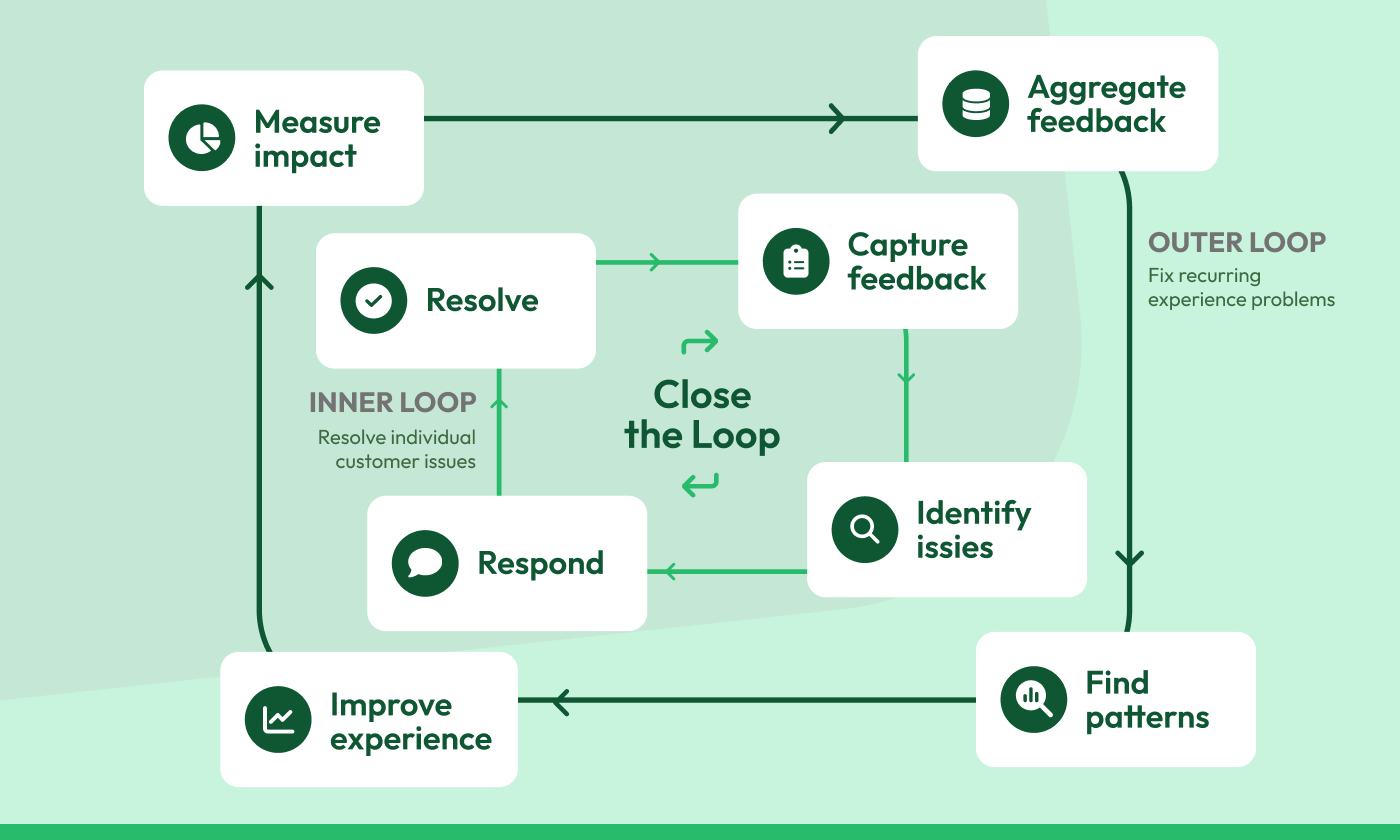
Most CX teams are good at collecting feedback. Far fewer are good at doing something with it. Closing the loop is the discipline that bridges that gap. It is how you turn a feedback program into something that actually changes the experience, reduces churn, and gives you the evidence to prove it.
There are two parts to it. The inner loop is about resolving individual customer issues quickly and reliably. The outer loop is about fixing the root causes that keep generating those issues in the first place. You need both. And most teams are much stronger on one than the other.
Key takeaways
- Inner loop resolution is table stakes. The programs that prove their value are the ones fixing root causes through the outer loop
- The outer loop stalls when CX teams cannot connect feedback themes to commercial impact and get cross-functional buy-in
- AI-powered text analysis makes root cause identification practical at scale
- Shared dashboards and quantified evidence are what move outer loop findings from a slide in a deck to a funded initiative
The inner loop: resolution at the individual level
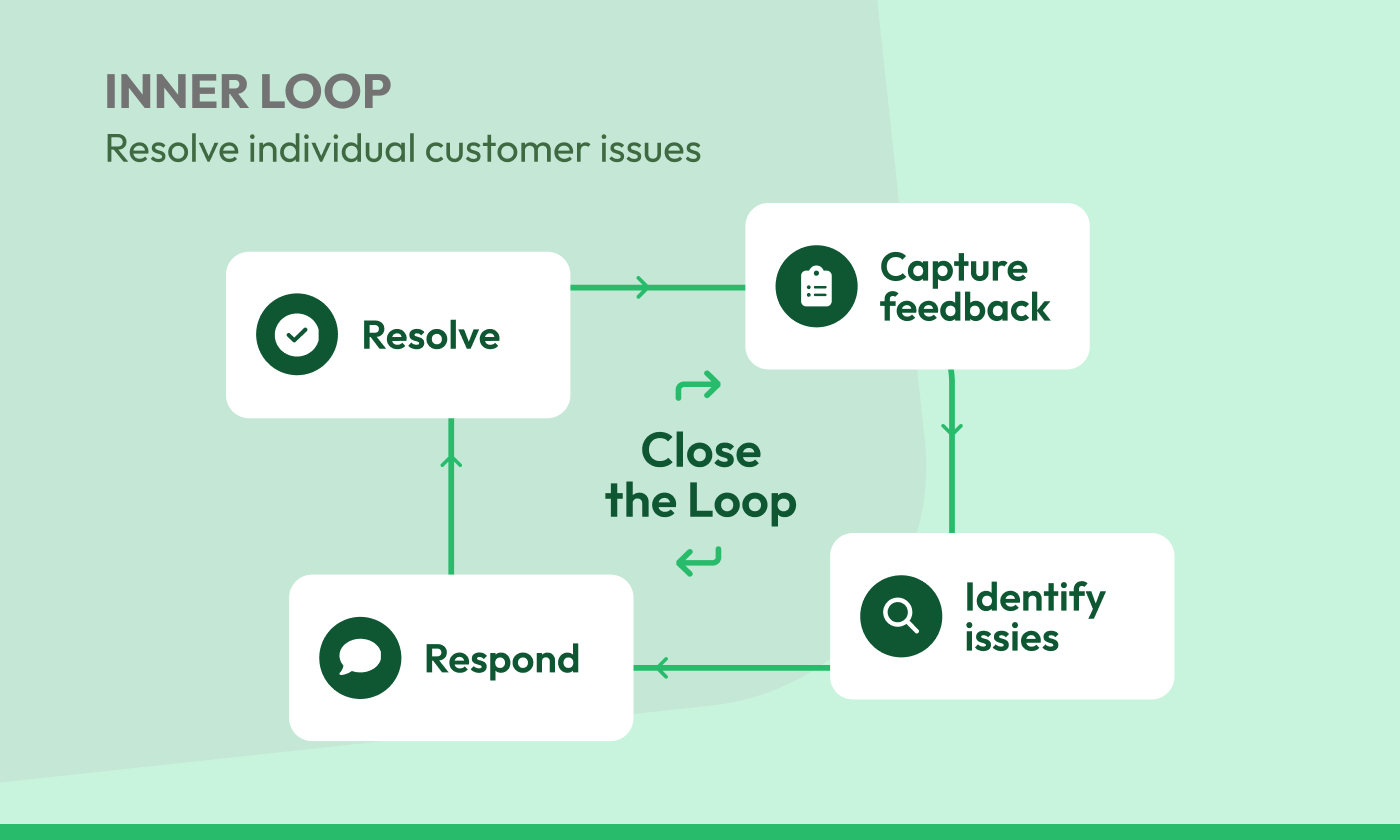
The inner loop is about what happens after an individual customer shares their experience. Someone responds. The issue gets handled. The customer hears back. Done well, it is one of the highest-leverage retention activities a CX team can run. Done inconsistently, it is a missed opportunity at scale.
The inner loop has four stages: capture feedback, identify issues, respond, and resolve.
1. Capture feedback
Good inner loop management starts with capturing feedback at the right moment in the right place. That sounds obvious, but a lot of programs get this wrong. They send a survey two days after the experience. Or they collect feedback through one channel while customers are talking on another. By the time the response lands, the moment has passed.
Best practice is to trigger feedback collection based on what the customer actually did. A purchase completion, a support ticket closure, an onboarding milestone. Feedback collected in the moment is more accurate, more actionable, and gets higher response rates.
The same principle applies to digital experiences. Feedback embedded in a website, product, or app captures what customers think about a specific page or feature in context. That specificity is what makes the next stage, identifying what needs attention, much more precise.
2. Identify issues
Not every response needs action. Reviewing everything manually at volume is not a strategy. The best CX teams automate this stage entirely.
Sentiment analysis can automatically flag responses with negative sentiment. Alert routing can notify the right person the moment a response hits a defined threshold or falls into a particular theme. That combination means the responses that need attention surface immediately rather than sitting in a dashboard waiting for someone to find them.
Thresholds do not have to be score-based either. In social housing, a damp or mold complaint must be addressed within a regulatory timeframe regardless of what score the respondent gave. Configuring alerts around theme classification means no response that requires action gets missed because of volume, timing, or who happened to be looking at the data.
3. Respond
Speed matters more than most teams realize. A customer whose response was acknowledged within 24 hours has a materially different retention profile to one who heard nothing. This is one of the most well-evidenced findings in CX research and one of the most consistently underexecuted.
Responding well means getting back to the customer quickly with the right context from the right person. Automated acknowledgement should go out immediately. A case should open with a named owner and the full response included. A generic sorry-to-hear-that reply does little. Customers want to know their specific issue has been understood and that the person handling it has the ability to fix it.
4. Resolve
Resolution means the issue is actually fixed. Not just acknowledged.
A case should only close when there is a documented outcome: what the problem was, what action was taken, and whether the customer was satisfied. That audit trail is what makes the inner loop reliable over time. It is also what holds up to scrutiny from regulators, senior stakeholders, and complaints functions.
There is another benefit to good resolution data that often gets overlooked. The patterns visible across hundreds of closed cases, what keeps recurring, what took longest to resolve, what generated escalations, are where outer loop analysis begins. The inner loop feeds the outer loop.
The commercial case is well established. Research from Bain and Company links a 7-point NPS improvement to 1% revenue growth. A meaningful proportion of that comes from retaining customers who would have churned after a poor experience that nobody followed up on.
The outer loop: fixing the causes, not the symptoms
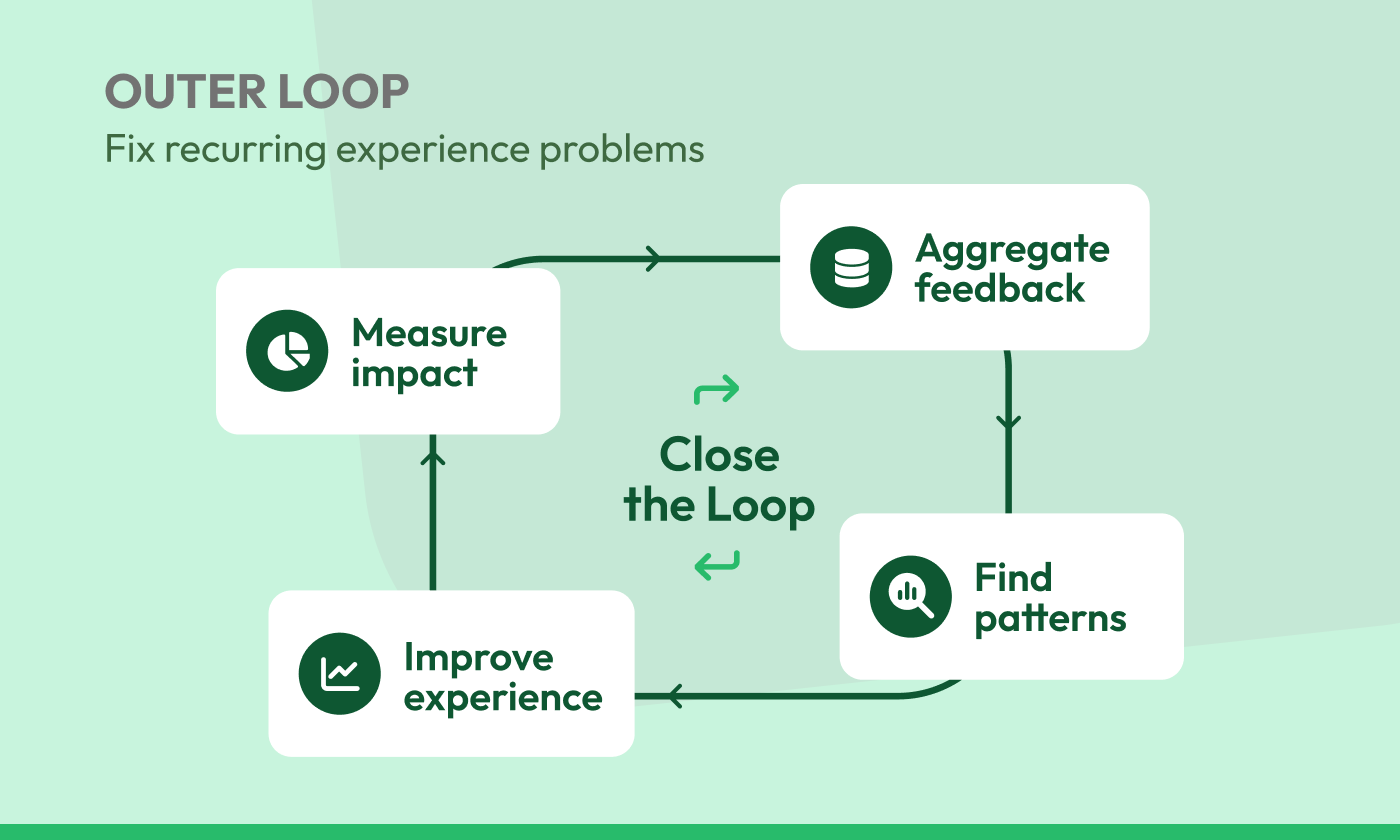
If the inner loop is about resolving individual issues, the outer loop is about making sure those issues stop happening. It is slower, more complex, and requires influencing people outside the CX function. It is also where the real commercial value of a CX program gets unlocked.
Most teams find the inner loop manageable. The outer loop is where programs stall. The four stages are: aggregate feedback, find patterns, improve experiences, and measure impact.
1. Aggregate feedback
You cannot spot systemic issues in fragmented data. The outer loop starts by bringing all feedback together into a single view. Across channels, time periods, customer segments, and touchpoints.
When everything sits together, you start to see which issues are isolated incidents and which are recurring across the customer base. Aggregation also enables comparison. Is the issue worse for customers who contacted support? Does it cluster around a specific product or region? Those questions only get answered when the data is in one place.
2. Find patterns
Volume of feedback is not the same as understanding. The pattern-finding stage is about identifying which themes are driving score movement, then going deep enough to understand what is actually behind them.
Start with the high-volume themes. The topics appearing most frequently across your responses. Then look at which of those themes are the key drivers of metric movement. A theme that appears heavily among low-scoring responses is a different priority to one that appears among satisfied customers. Understanding which themes are actually moving your NPS, CSAT, or CES is the foundation of the outer loop.
Identifying a theme, though, is only the surface level. To build a case for change you need to go deeper. Drill down from the theme into sub-themes and specific topics. Then drill down further into the verbatim responses sitting underneath.
Knowing that 'communication' is a high-volume theme is useful. Knowing that within that theme the specific topic of 'update frequency after a complaint is raised' appears heavily in low-scoring responses, and being able to read the verbatim comments that confirm exactly what customers mean by it, is what turns an observation into an actionable insight. That level of specificity is what you need to build a case that actually gets something fixed.
The same process works in the other direction too. Which themes cluster around high scores? Which touchpoints consistently produce happy customers? The outer loop should be as much about identifying what to scale as what to fix.
3. Improve experiences
Identifying a problem and getting it fixed are two very different challenges. This is where the outer loop most often stalls.
Getting a product team, an operations director, or a technology function to reprioritise based on CX data requires more than sharing a verbatim comment or a score. It requires a business case. What is the frequency of this theme across the customer base? What does the score profile look like for customers who mention it? What would a meaningful reduction in that frequency mean for retention?
When CX teams can answer those questions with data, the conversation with the rest of the business changes. It shifts from 'customers are unhappy about X' to 'fixing X is worth a quantified amount in retained revenue'. That is a very different meeting.
Shared dashboards help too. A product team with direct visibility into the themes behind low post-launch scores is more likely to act than one that receives a summary slide in a monthly meeting. Visibility creates accountability.
4. Measure impact
When a change ships, its impact on the relevant metric needs to be tracked and attributed. Did NPS improve for that touchpoint? Did the frequency of that theme in low-scoring responses fall? Did scores in the affected segment move?
This is what turns a CX finding into a CX result. Programs that can show a clear before-and-after story are the ones that retain leadership support over time. Those that cannot tend to find their budgets questioned at the next planning cycle.
Why closing the loop is the cornerstone of a CX strategy
A rising NPS score is a result, not a strategy. The strategy is the disciplined process of identifying what is moving that score and acting on it, repeatedly, with documented outcomes.
Closing the loop is that process. It connects feedback to action, action to outcomes, and outcomes to evidence. Without it, CX sits at the edge of business decision-making. With it, CX teams have the data to influence roadmaps, justify investment, and defend their budgets in language that resonates with finance.
A 5% improvement in customer retention can lift profit by 25 to 95% (Harvard Business Review). Getting there requires a functioning outer loop, one that identifies and fixes the recurring issues driving churn rather than just resolving individual complaints.
How SmartCX helps CX teams close the loop
SmartCX is built around the entire loop. Here is how the platform supports each stage.
Capturing feedback across the customer journey
A closed loop starts with feedback collected at the right moment. SmartCX's feedback capture distributes surveys via email, SMS, website pop-ups, web embeds, QR codes, offline and kiosk, and tracking links. Collection is triggered by customer actions and journey events so feedback is captured when the experience is freshest and response rates are at their highest.
Uncovering what is actually driving your scores
SmartCX's analytics capabilities surface the themes and sentiment behind score movement. Which themes appear most in low-scoring responses? Which touchpoints correlate with high effort? Which interactions consistently produce satisfied customers? Answering those questions with confidence requires more than reading responses at random.
Text and thematic analysis at scale
SmartCX's text and thematic analysis uses AI to group open-text responses into themes automatically. That makes drill-down from theme to sub-theme to verbatim practical at scale. A theme with volume and commercial weight behind it, supported by the verbatim evidence to explain it, is a business case not an opinion.
Closing the inner loop with case management
SmartCX includes built-in case management. Responses meeting defined criteria automatically generate cases with named owners, the full verbatim attached, and a status that tracks through to resolution. Nothing requires a manual handoff and no case slips through.
For teams with established helpdesk or CRM workflows, SmartCX integrates directly. Cases and context flow into Salesforce, HubSpot, or wherever the team already works, via API, webhooks, and pre-built connectors.
Closing the outer loop with dashboards and evidence-based cases for change
SmartCX helps CX teams build the before-and-after evidence that turns a finding into a funded initiative. Shared dashboards give relevant stakeholders direct visibility into the metrics and themes that matter to their function. The platform's analysis tools track whether changes made actually moved the metrics they were supposed to move.
Frequently asked questions
What is the most common failure point in closing the outer loop?
Getting cross-functional buy-in. CX teams can identify root causes accurately but often lack the commercial evidence to move them up the priority list for product, ops, or technology teams. The outer loop works when CX teams present quantified impact, not just feedback themes.
How is SmartCX different from platforms like Pisano for closing the loop?
Pisano's approach focuses heavily on workflow automation and task management within the platform. SmartCX gives CX teams the same inner loop resolution capability, either natively or by integrating with the tech stack already in place, but places equal emphasis on the outer loop. Root cause identification through AI-driven text and thematic analysis, shared dashboards that create stakeholder visibility, and the before-and-after evidence that builds the business case for systemic change. For CX teams trying to prove commercial impact rather than just manage cases, that outer loop capability is where programs succeed or stall.
Does SmartCX replace our existing helpdesk or CRM?
Not necessarily. SmartCX includes its own case management tools, which work well for teams that want the feedback and resolution workflow in one place. For teams with established helpdesk or CRM workflows, SmartCX integrates directly so cases and context flow through to the tools people already use. Either approach keeps the loop closed without disrupting how the team operates.
How do we build a credible business case for fixing an outer loop issue?
Start with the theme's frequency in low-scoring responses, then connect it to churn risk in that customer cohort. Model what a meaningful reduction in that frequency would mean for retention. The SmartCX ROI calculator lets you model the commercial impact before you walk into the meeting.
What does best practice inner loop management look like at scale?
Automated identification of responses that need action, based on sentiment or theme classification. A named owner for every case. A defined response timeframe, typically 24 hours. Acknowledgement triggered immediately. And a full audit trail through to resolution.
Ready to close the loop?
SmartCX gives CX teams everything they need to resolve individual issues and fix the root causes behind them, in one platform. Book a 30-minute call to see how it works for your program.


Alex is a growth marketing leader who has led digital transformation through AI and technology across multiple organizations. With experience across SaaS and the customer experience space, he knows what it takes to turn technology into business impact. Alex shares knowledge on feedback collection, text analysis and feedback management, helping organizations get more value from their feedback programs.
See SmartSurvey in action


